

Nissen Fundoplication (GERD Surgery)
- GI & Bariatric Surgery
- Whipple Surgery
- Bariatric Surgery
- Liver Resection
- Gastro Esophageal Surgeries
- Colorectal Surgeries
- Appendectomy
- Hemorrhoidectomy
- Partial Colectomy
- Nissen Fundoplication
- Peptic / Gastric Ulcer Treatment
- Piles Surgery
- Gastrointestinal Surgery
- Surgery for Morbid Obesity
- Hepatopancreaticobiliary Surgery
- Post-Cholecystectomy Bile Duct Injury
- Incisional Hernia
- Minimally Invasive Surgery
- Gallbladder (Biliary) Stone Treatment
Nissen Fundoplication (GERD Surgery)
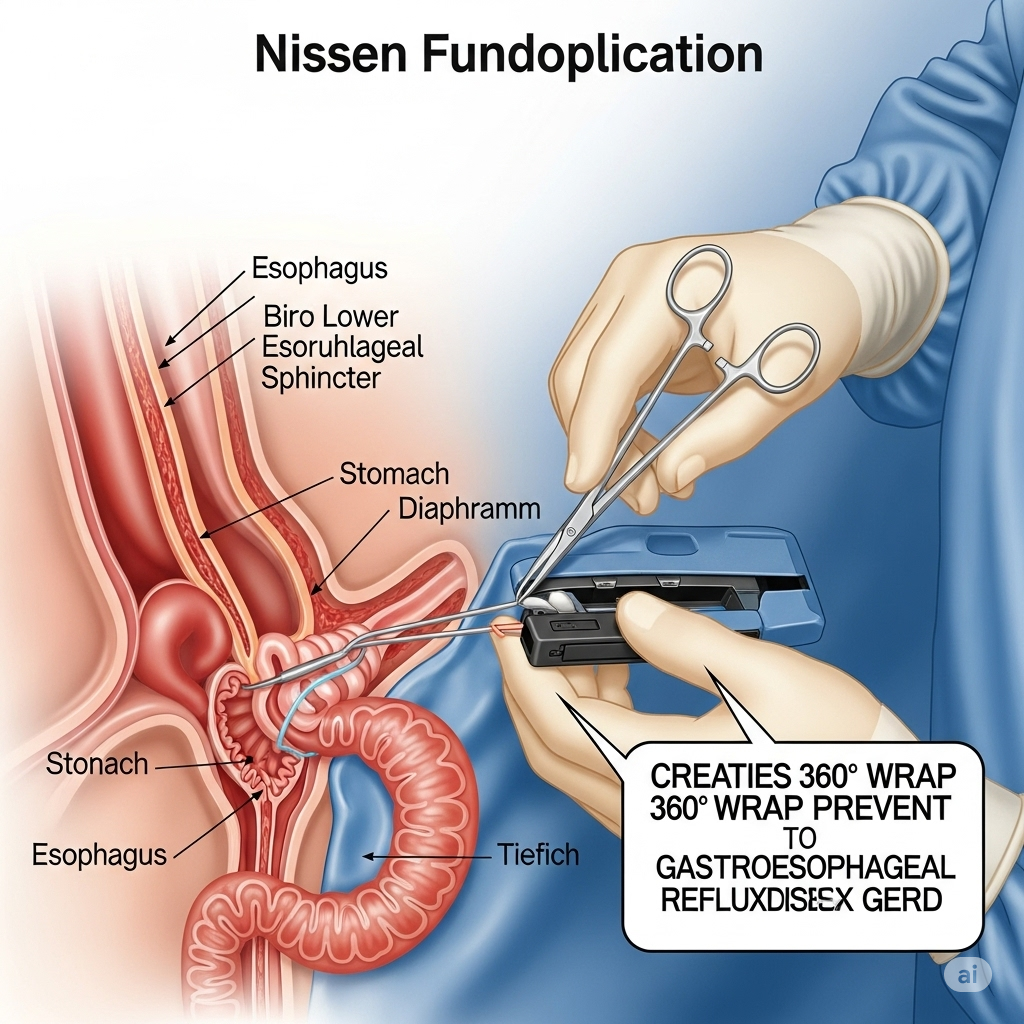
Nissen Fundoplication: Surgical Treatment for Severe GERD
**Nissen Fundoplication** is a surgical procedure primarily performed to treat **Gastroesophageal Reflux Disease (GERD)** and **hiatal hernias**. It involves reinforcing the lower esophageal sphincter (LES), the valve between the esophagus and stomach, by wrapping the upper part of the stomach (fundus) around the lower esophagus. This creates a new, tighter valve, preventing stomach acid and contents from flowing back into the esophagus. While Dr. Neeraj Dhar, as a leading Gastroenterologist, does **not** perform this surgery, he plays a crucial role in the **diagnosis, pre-operative assessment, and post-operative gastrointestinal management** of patients considering or undergoing Nissen Fundoplication in Faridabad.
Understanding GERD and When Nissen Fundoplication is Needed:
GERD occurs when stomach acid frequently flows back into the tube connecting your mouth and stomach (esophagus). This backwash can irritate the lining of your esophagus, leading to symptoms like heartburn and regurgitation. When GERD is severe, unresponsive to lifestyle changes and medication, or complicated by conditions like hiatal hernia, esophagitis, strictures, or Barrett's esophagus, surgery like Nissen Fundoplication may be considered.
Indications for Nissen Fundoplication:
- **Severe Chronic GERD:** When symptoms persist despite optimal medical therapy (e.g., proton pump inhibitors - PPIs).
- **Hiatal Hernia:** Especially when it contributes significantly to GERD symptoms.
- **Complications of GERD:** Such as severe esophagitis, esophageal strictures (narrowing), or recurrent aspiration.
- **Barrett's Esophagus:** In select cases, to prevent further progression of cellular changes.
- **Patient Preference:** Individuals who do not wish to take long-term acid-suppressing medication.
- **Extra-esophageal Symptoms:** Such as chronic cough, asthma, laryngitis, or dental erosion, if proven to be caused by GERD.
Types of Nissen Fundoplication Procedures:
Nissen fundoplication can be performed using different surgical approaches:
1. Laparoscopic Nissen Fundoplication (Minimally Invasive):
- This is the most common approach today.
- The surgeon makes several small incisions in the abdomen.
- A laparoscope (a thin tube with a camera) and specialized surgical instruments are inserted.
- The fundus of the stomach is wrapped 360 degrees around the lower esophagus and secured.
- **Benefits:** Smaller incisions, reduced pain, shorter hospital stay, faster recovery, and minimal scarring.
2. Open Nissen Fundoplication:
- Involves a single, larger incision in the abdomen.
- This approach may be necessary for complex cases, patients with extensive previous abdominal surgeries, or certain anatomical considerations.
3. Robotic-Assisted Nissen Fundoplication:
- A more advanced minimally invasive technique utilizing robotic arms for enhanced precision and visualization, particularly for complex cases.
Preparation for the Procedure:
Thorough evaluation is key before Nissen Fundoplication. Dr. Neeraj Dhar's diagnostic expertise is crucial during this phase:
- **Diagnostic Endoscopy (EGD):** To visualize the esophagus, stomach, and duodenum, assess the severity of esophagitis, and identify any hiatal hernia or other abnormalities.
- **Esophageal pH Monitoring (pHmetry):** Such as 24-hour pH study or wireless pH monitoring (Bravo capsule), to objectively measure the amount of acid reflux and confirm GERD, especially if symptoms are atypical or respond poorly to medication.
- **Esophageal Manometry:** To measure the strength and coordination of esophageal muscle contractions and the function of the lower esophageal sphincter. This test is vital to rule out underlying motility disorders that could impact surgical success.
- **Imaging Studies:** Barium swallow or CT scan may be performed.
- **Lifestyle Modifications:** Patients are advised on dietary changes, weight management, and smoking cessation.
- **Fasting:** Patients are instructed not to eat or drink anything for a specified period before surgery.
Recovery and Post-Procedure Care:
- **Hospital Stay:** Typically 1-3 days for laparoscopic surgery, longer for open procedures.
- **Pain Management:** Pain medication will be provided.
- **Diet Progression:** A gradual return to diet, starting with liquids, progressing to soft, pureed foods, and then solids over several weeks. Avoiding carbonated beverages and foods that produce gas is often recommended.
- **Activity:** Early ambulation is encouraged. Strenuous activities and heavy lifting are usually restricted for 4-6 weeks.
- **Follow-up:** Regular follow-up appointments with the surgical team and Dr. Neeraj Dhar are crucial to monitor recovery and manage any persistent GI symptoms.
Potential Risks and Complications:
While Nissen Fundoplication is generally safe, potential complications can include:
- **Dysphagia (Difficulty Swallowing):** Common initially, usually temporary, but can be persistent in some cases if the wrap is too tight.
- **Gas-Bloat Syndrome:** Difficulty belching or vomiting, leading to abdominal bloating and discomfort due to the inability to release swallowed air.
- **Recurrent GERD:** If the fundoplication wrap loosens or breaks down over time.
- **Wound infection or bleeding.**
- **Damage to nearby organs** (e.g., esophagus, spleen, vagus nerve).
- **Adhesions** (scar tissue formation).
- **Diarrhea or changes in bowel habits.**
- **Anesthesia-related risks.**
Dr. Neeraj Dhar's Expertise in GERD Management:
Dr. Neeraj Dhar's role as a Gastroenterologist is indispensable for patients considering or undergoing Nissen Fundoplication:
- **Expert Diagnostic Workup:** He performs crucial pre-operative tests like endoscopy, pHmetry, and manometry to accurately diagnose GERD, assess its severity, identify any underlying esophageal motility issues, and determine if the patient is a suitable candidate for surgery.
- **Pre-operative Optimization:** Dr. Dhar ensures that patients are optimally prepared for surgery, managing any concurrent GI conditions and providing guidance on lifestyle and dietary modifications.
- **Medical Management before Surgery:** He guides patients through medical therapy for GERD and helps determine when surgical intervention becomes the most appropriate next step.
- **Post-operative Gastrointestinal Support:** After surgery, Dr. Dhar provides expert management for any post-operative GI symptoms or complications, such as persistent dysphagia, gas-bloat syndrome, or new onset digestive issues. He can perform follow-up endoscopies if needed.
- **Long-Term Follow-up:** He continues to monitor patients long-term for any recurrence of GERD symptoms or complications, ensuring sustained relief and overall digestive health.
If you are experiencing chronic or severe GERD symptoms, consult with Dr. Neeraj Dhar in Faridabad for a thorough evaluation and to discuss whether Nissen Fundoplication or other treatment options are suitable for your condition. His comprehensive approach ensures personalized and effective care.